Request a Dutch CIT fiscal unity
Upload the KvK extracts, answer the questions and download the completed Belastingdienst forms: Part A, a Part B per subsidiary and Part C if needed. You sign and send them yourself.
Is it about VAT? For a VAT fiscal unity you prepare a request letter: prepare the VAT request letter. Want the rules first? What is a Dutch CIT fiscal unity?
Free check and free preview. You pay € 39 excl. VAT only when you download the completed forms.
- KvK 42057580
- GDPR-compliant, processed in the EU
- No storage after delivery
Tax advisor or accountant? Prepare requests for multiple clients through lowkeyautomation.com.
From KvK extract to a completed request
All the forms
Part A, a Part B per subsidiary, and Part C only if a subsidiary already heads an existing fiscal unity, filled automatically and ready to sign.
Checks the requirements
The tool tests your data against the requirements of article 15 CIT Act before you pay.
Data from your extract
Upload the KvK extract and the tool fills in the name, RSIN and registered city where possible. You check everything before you download.
Done in four steps
Run the free check
Six questions on the conditions of article 15 CIT Act, and four situations that rule it out.
Upload the KvK extracts
One extract for the parent and one per subsidiary. The tool fills in the data where possible; you check and complete it.
Fill in the final details
The consolidation date, the date the parent acquired the shares, and who signs.
Download, sign and send
You print the forms, have them signed, and mail them to your tax office.
What you receive
After payment the download starts right away in your browser: one zip file. Nothing goes by email.
- deel-a.pdf: Part A with the parent company's details and the chosen consolidation date.
- deel-b-1.pdf, deel-b-2.pdf and so on: one Part B per subsidiary.
- deel-c-….pdf: only when a subsidiary already heads an existing fiscal unity. The tool fills in up to six already-consolidated companies per Part C.
- begeleidende-brief.docx: a cover letter in Word. You add the tax office and sign it.
- README.txt: the steps for signing and sending.
- Your KvK extracts, if you uploaded them.
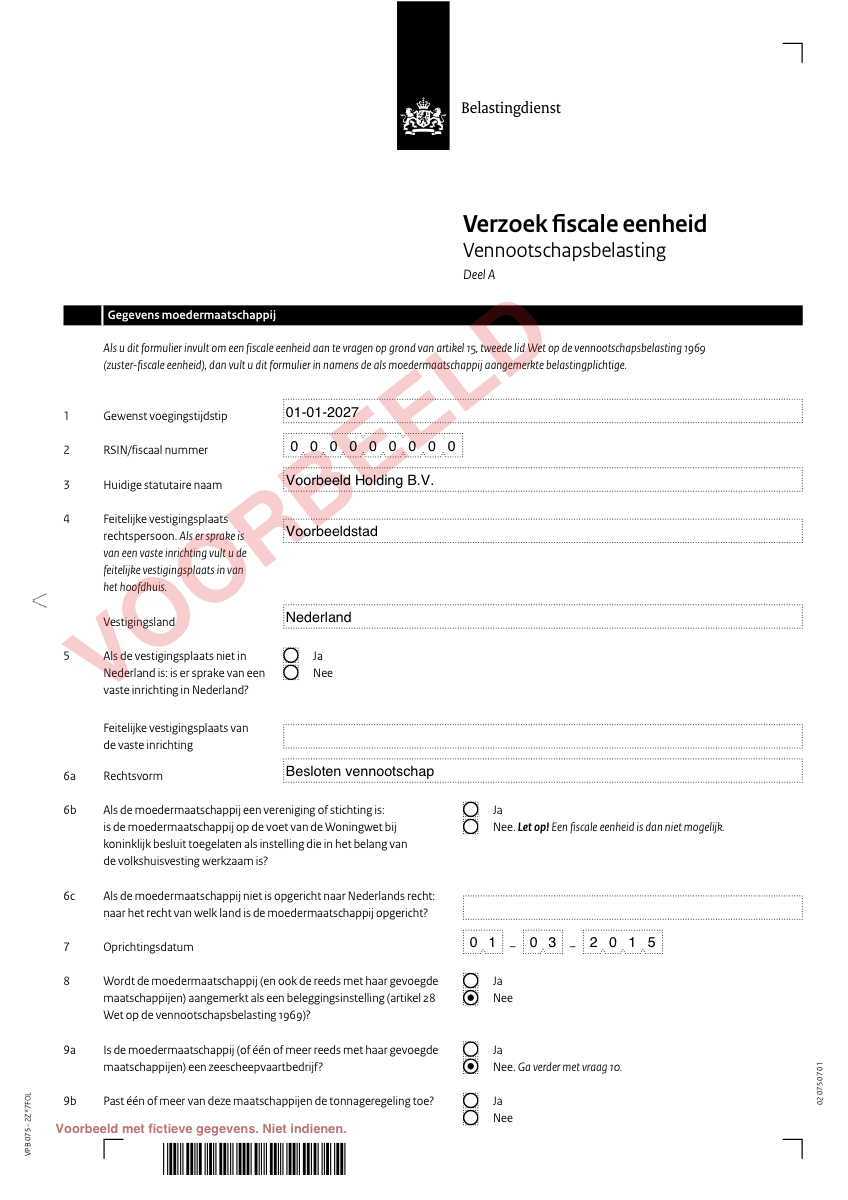
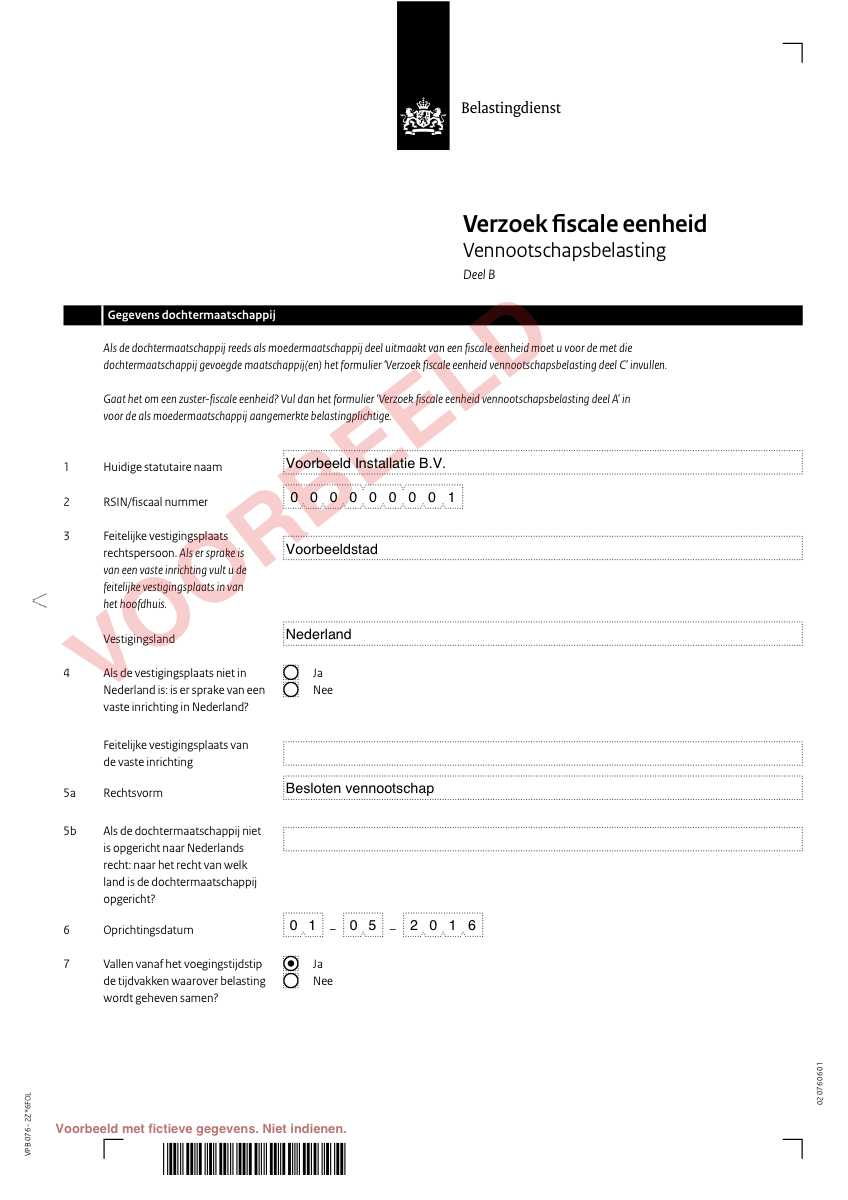
A sample with fictitious data, built with the same fill code as your own forms.
What do you need?
- Per company: KvK number, RSIN, statutory name, registered city, legal form and incorporation date. These are on the KvK extract; upload it and the tool fills in these fields where possible.
- Per subsidiary: the date the parent acquired legal and economic ownership of the shares (Part B, question 9b).
- Per subsidiary: a copy of the share-transfer deed(s). Part B asks you to attach them.
- Per subsidiary: preferably the KvK extract showing the parent is the sole shareholder.
- The desired consolidation date.
- Who signs: name and date for the parent and for each subsidiary, and a phone number for the parent.
- Part C only: the date and number of the existing fiscal unity’s ruling, and the name and RSIN of the companies already in it.
Which situations does the tool support?
Supported
- A Dutch-resident parent (bv, nv, cooperative or mutual insurer) with one or more Dutch subsidiaries (bv or nv), up to 50 subsidiaries per request.
- The parent holds at least 95% of the shares, voting rights and entitlement to profit and net assets in each subsidiary. More detail
- The parent and subsidiaries share the same financial year and the same profit-determination rules.
- Adding a subsidiary to an existing fiscal unity: you file Part A and a Part B for the new subsidiary. More detail
- A subsidiary that already heads its own fiscal unity: the tool fills in Part C.
Not in the tool, have a specialist assess this
- A Papillon or sister fiscal unity (a foreign intermediate or top company).
- A parent or subsidiary not established in the Netherlands, including one with only a Dutch permanent establishment.
- A fiscal or exempt investment institution (FBI or VBI).
- Shares certificated through a trust office (STAK).
- A functional currency other than the euro, or the tonnage regime.
- A housing corporation as parent.
- A reliance on article 4 Fiscal Unity Decree 2003, which requires an explanation in a separate annex.
Was a subsidiary incorporated shortly before the consolidation date? The check flags this; you complete the first-financial-year question on Part B yourself.
What is free and what does it cost?
Free: the eligibility check, a check of all your data against the requirements of article 15 CIT Act 1969 before you pay, and a watermarked preview of the first page of each form. You pay € 39 excl. VAT per download, only when you download the complete set. VAT is calculated at checkout.
Signing and sending
- 1Print the forms. The Belastingdienst asks you to print and sign them.
- 2Have Part A signed on behalf of the parent and each Part B on behalf of the relevant subsidiary.
- 3Mail everything with the annexes to the tax office responsible for the parent company. Find the address with the official tax-office lookup.
Prefer to fill it in yourself? The blank forms are free on the Belastingdienst's forms page.
Timeline
You choose the consolidation date: the date the fiscal unity should start.
The request must be filed within three months of that date. The fiscal unity starts on the requested date, “but not more than three months before the moment the request was made” (article 15(9) CIT Act 1969). Count from the moment the Belastingdienst receives your request, not the date you download or sign. Example: consolidating as of 1 January 2027 means the request must reach the Belastingdienst by 1 April 2027 at the latest. More on retroactive effect: Dutch CIT fiscal unity with retroactive effect.
The Belastingdienst says it decides on your request within 8 weeks. After that, the parent company files the corporate income tax return for the whole fiscal unity; the subsidiaries no longer file their own returns. Drawbacks and risks.
Questions about the fiscal unity
What is a corporate income tax fiscal unity?
A fiscal unity lets a parent company and one or more subsidiaries file a single corporate income tax return as one taxpayer (Article 15 Dutch CIT Act). Their results are consolidated into one return.
What are the requirements?
The parent holds at least 95% of the legal and economic ownership of the subsidiary shares, both entities use the same financial year and profit-determination rules, and both are established in the Netherlands. Usually this means a BV or NV.
What are the benefits?
Losses of one company can be offset against profits of another, intra-group transactions are tax-neutral, and the group files one corporate income tax return instead of several.
When does the fiscal unity take effect?
You choose the consolidation date. The request must reach the Belastingdienst within three months of that date, so the consolidation date can be at most three months before the request.
How do I file the request?
You complete the Belastingdienst forms (Part A and Part B, and Part C only if a subsidiary already heads an existing fiscal unity), sign them and send them by post to your tax office. This tool fills the forms for you based on your KvK data. Is your accountant or tax advisor preparing the request on your behalf? They prepare that via Lowkey.
More about the CIT fiscal unity
What is a Dutch CIT fiscal unity?
Full explainer: definition, the requirements, benefits, drawbacks, and how to file a request with the Belastingdienst.
Read articleGuideWhat is a VAT fiscal unity?
Interlinkage, conditions, ruling and how to request a Dutch VAT fiscal unity, with a tool that drafts the request letter.
Read articleBlogHow to request a Dutch CIT fiscal unity
Step by step: which forms you need, how the process works and what deadlines apply when requesting a CIT fiscal unity in the Netherlands.
Read articleBlogDisadvantages and risks of a Dutch CIT fiscal unity
Joint and several liability, one low-rate bracket for the whole group, and the 15ai recapture rule: the downsides of a Dutch fiscal unity explained.
Read articleBlogEnding a Dutch CIT fiscal unity (deconsolidation)
How to end a Dutch CIT fiscal unity: voluntary request vs automatic termination, the 15ai recapture rule, loss allocation and liability after separation.
Read articleWho built this?
This tool was built by Lowkey Automation in Amsterdam (KvK 42057580). It fills the official Belastingdienst forms based on your KvK data and your answers.
This tool prepares the official forms but is no substitute for personal tax advice. Verify all data before submitting the request.
Ready to file your request?
Run the free check and see within minutes whether a fiscal unity is available.